
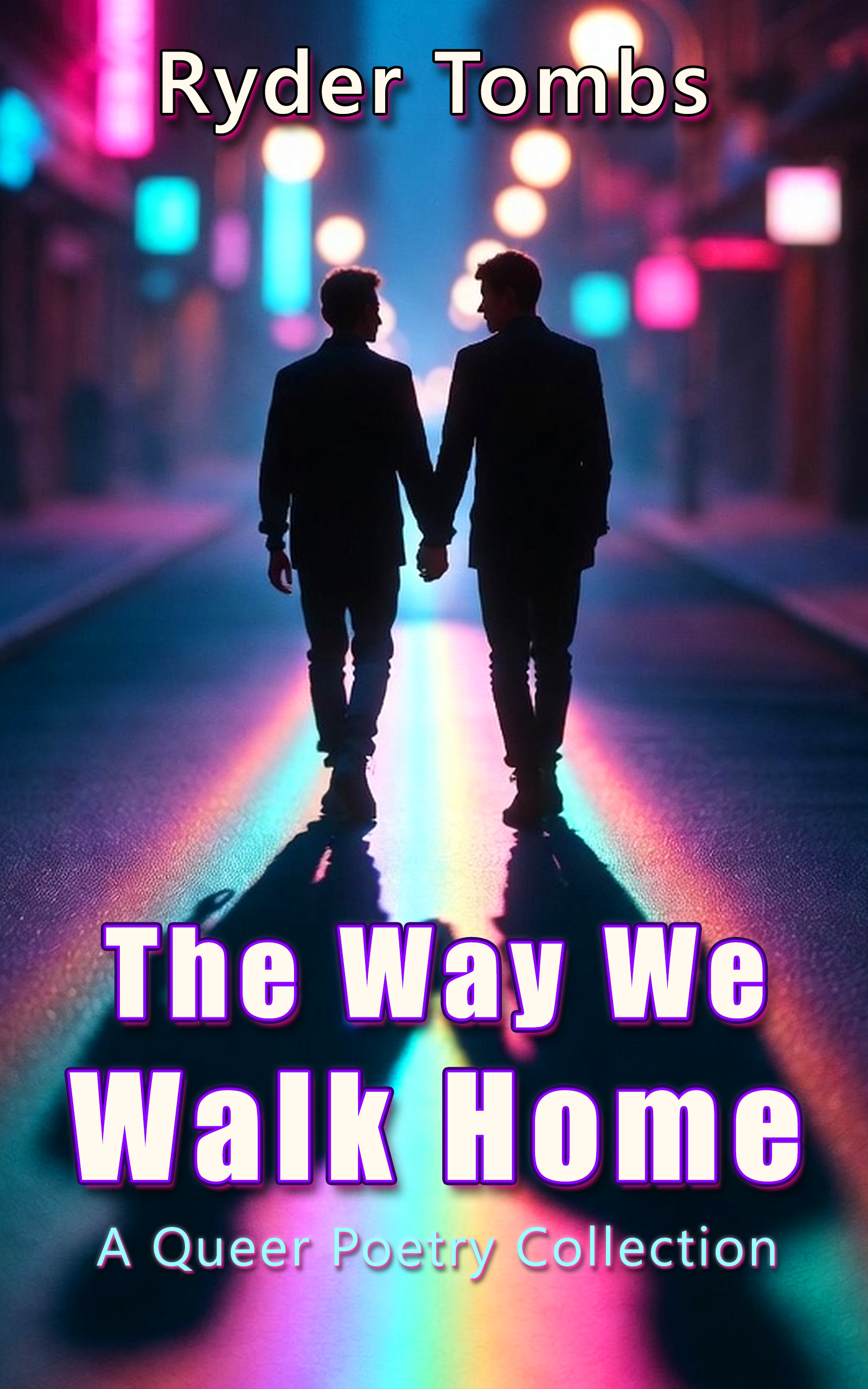


I did not mean to write a decade-long love letter to my own survival. It happened poem by poem, notebook by notebook, word by word.
When I began these poems ten years ago, I was not trying to make a book. I was trying to make sense of myself. The world felt louder then, or maybe I was quieter. I wrote in margins and text threads, on napkins and the backs of receipts, as if language itself could hold the chaos that being queer sometimes meant.
Looking back, I see that the act of writing was its own kind of resistance. Not a grand protest, but something smaller and more intimate. A refusal to disappear.
Writing as Survival
I have journals from those years filled with cramped handwriting, half-finished lines, and ink smudged by tears or coffee. Some entries are nearly illegible, written at three in the morning when I was still afraid of my own tenderness.
I found them again while cleaning during lockdown. Dusty stacks of old notebooks, tucked behind winter scarves and forgotten hopes. When I opened them, it felt like stumbling across the ghost of someone I used to be, a stranger who somehow knew me better than I remembered knowing myself.
Reading those old lines, I felt something I had not expected: awe. Not because the poems were brilliant, but because they were honest. They carried the full, unfiltered pulse of who I was when I still thought I had to hide it.
Each poem felt like a message in a bottle from a younger self who had not yet learned how to speak openly. “Here,” those poems seemed to say. “I made this for you, just in case you ever forget how far we have come.”
And I had forgotten. That was the strangest and most beautiful part.
The Stranger in the Notebook
There is a kind of quiet heartbreak in reading your own words and realizing you do not recognize them at first. Some of these poems felt as if they had been written by someone else entirely. Some were frightened, some fierce, all reaching for the light.
I found a love poem I wrote in 2014 that made me laugh out loud because it was so earnest and clumsy. I found another written after a protest that still smelled faintly of rain and adrenaline.
For a moment, it felt as if I were reading a stranger’s diary. And yet that stranger had my handwriting.
That feeling, that recognition from afar, was its own revelation. It reminded me that empowerment does not always happen in loud moments. Sometimes it happens slowly, quietly, over years of showing up for yourself on the page.
Writing taught me that healing does not arrive with fanfare. It creeps in through revision, through rereading, through realizing you survived something you did not even have language for at the time.
Queer Empowerment as Continuum
There is a story people like to tell about queer empowerment, that it begins in pain and ends in pride. The truth is far more complicated, and far more beautiful.
Empowerment is not a destination. It is a rhythm, a breath in and a breath out. Some days you march. Some days you rest. Some days you dance in the streets. Other days you sit quietly and let yourself exist without needing to prove anything.
When I started writing these poems, I thought power meant volume, being louder than the world that wanted me small. Over time, I realized it also means listening. Listening to your own history, to your community, to the silence that lingers after the chants fade.
There is empowerment in gentleness. In forgiveness. In allowing yourself to love and be loved without needing to justify it.
The poems that make up The Way We Walk Home trace that shift. The early pieces are about fear, secrecy, and rage. They come from a place of urgency. As the years passed, the voice softened. Not because the fight ended, but because I learned that joy is also a form of resistance.
Joy is not the opposite of pain. It is what grows after pain has done its worst and failed to kill you.
Building a Future From Fragments
One of the greatest joys of writing queer poetry over ten years is watching language evolve with the community itself.
When I started, I used the word “bisexual” hesitantly, as if it were a secret code I might get wrong. I liked “queer” better. It felt elastic, defiant, alive. Over time, the poems stretched that word to hold multitudes: grief, lust, friendship, protest, faith.
As I wrote, I also learned to name things I once avoided. Anxiety. Loneliness. The quiet rage of being misunderstood. The small holiness of chosen family.
Each poem became a brick in the architecture of a self I was still building. Together, they formed something like a home.
It is funny. I used to think I was writing to change the world. In the end, I was writing to change my own reflection.
Finding Power in the Ordinary
When people talk about queer empowerment, they often picture parades and protests. But what has sustained me most over the last decade are the smaller, quieter moments.
A text from a friend saying, “I read your poem and it made me feel less alone.”
An older gay man at a reading who said, “We did not get to say this out loud when I was your age. Keep saying it.”
A morning spent editing a love poem with the person I wrote it for.
These are the real revolutions. The daily, ordinary acts of persistence and tenderness that keep us human.
Writing has taught me that empowerment is not about perfection. It is about presence. To sit with your past selves, to forgive them, to thank them for surviving long enough to give you the life you have now. That is the kind of power no one can legislate away.
A Decade in Bloom
Now, as I gather these poems into a book, I see how each section — The First Breath, The Static, The Noise, The Bloom — mirrors not only the queer journey but the creative one.
You begin with discovery. You confront chaos. You raise your voice. You grow into peace.
Ten years ago, I thought being queer meant being brave. Now I think it means being honest. To say: this is who I am, this is what I feel, this is how I love. And to know that honesty will ripple outward, touching others who need it.
The joy I feel now is not loud or performative. It is steady, rooted, expansive. It is the joy of knowing that every poem I wrote when I thought I was alone was actually a bridge to someone else.
I once wrote out of desperation. I write now out of gratitude.
The Way Home
Sometimes, when I flip through my old notebooks, I still find lines I do not remember writing. They feel like time capsules, preserved bits of hope I left for myself. I like to think that younger version of me trusted I would find them when I was ready.
When I read them now, it feels like meeting myself halfway.
That is what queer empowerment has become for me: not a single triumphant moment, but a lifelong conversation between all the people I have been and all the ones I am still becoming.
The poet who wrote those early drafts needed saving. The poet finishing this book finally knows they were never lost.
The joy, I have learned, is not in the destination. It is in the remembering.
It is in picking up a journal and seeing that even when you thought you were just surviving, you were already creating something beautiful.
The way we walk home is not always straight or easy. But it is ours, every step, every scar, every poem.
And that, I think, is the truest empowerment of all.
-Ryder

Discover more from Ryder Tombs
Subscribe to get the latest posts sent to your email.
